Store research
Check competitor stores and product context before testing.
Use case
Shopify sellers usually need a fast way to spot product angles, review competitor stores, and decide whether a product deserves a test. Winning Hunter can be useful if that process is already part of your weekly workflow.
Independent guide. Product-directed links may be affiliate links, and current terms should be verified on the live product page.
Last checked: August 12, 2026.
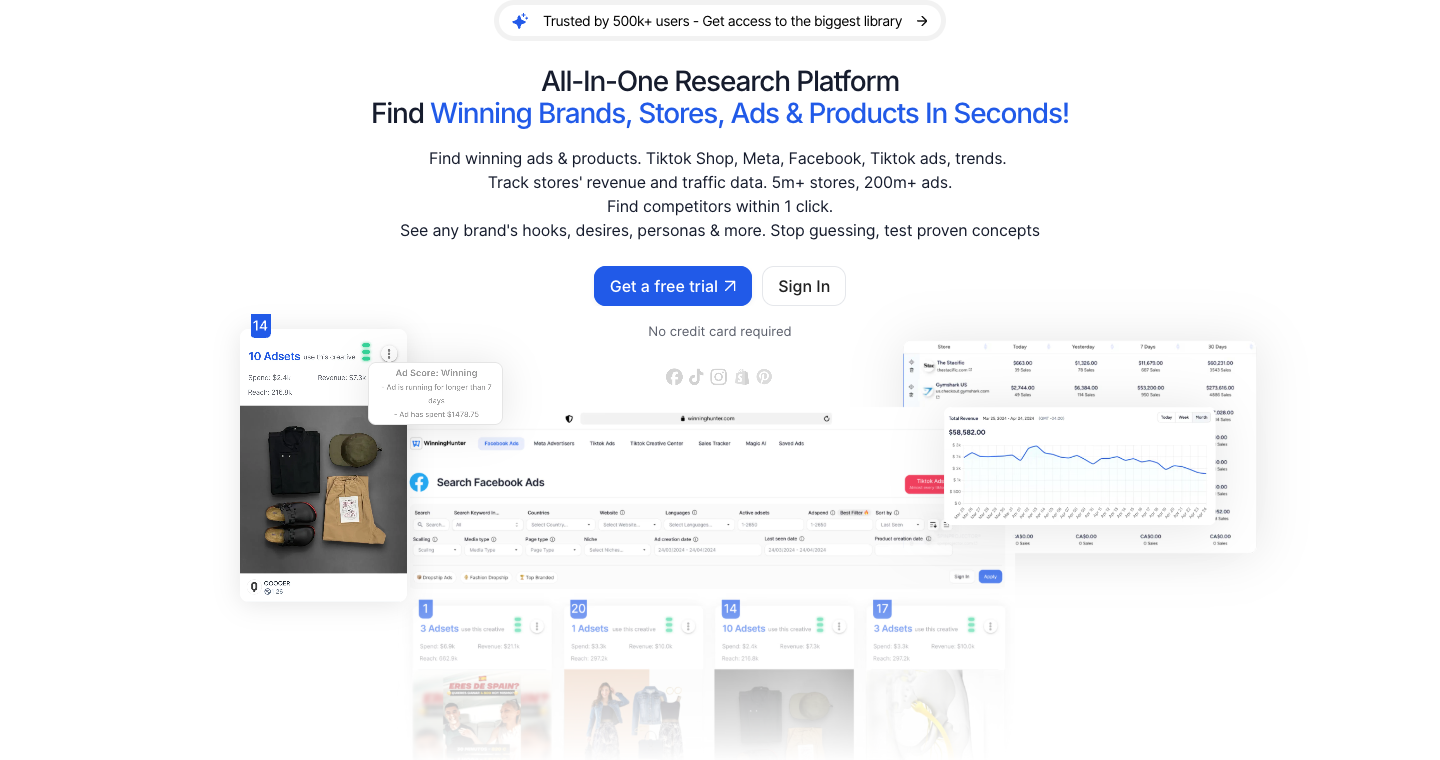
Check competitor stores and product context before testing.
Use ad examples to see how offers are framed and scaled.
Useful when your Shopify work depends on repeated research.
Use case
A Shopify seller typically needs product discovery, competitor checks, and a way to judge whether a product angle has enough room to test. Winning Hunter is positioned around ad research, store tracking, store exploration, and product importing, which can support that process.
That does not make it a Shopify-specific product. It is still a research tool, so the seller has to make the product, margin, fulfillment, and creative decisions outside the platform.
Find products and ad angles worth inspecting.
Check whether the same angle already looks crowded.
Validate margin, shipping, and creative capacity yourself.
Use case
The tool fits best when you already use research as a regular input before launching or scaling a store. If the same checks happen every week, a faster way to collect ad and store signals can be useful.
If you only run occasional tests, free sources may cover the job. The value rises when the workflow repeats.
Useful when you test products often.
Useful when competitor storefronts influence your selection.
Useful when multiple people share the same research routine.
Use case
If this use case matches your store, read the review and pricing pages before deciding. If you are still comparing tools, use the alternatives page first.
Use case
It can be useful for Shopify sellers who launch often, study competitor storefronts, and test products in a repeatable way. In that case, the ad and store signals can make the next test more informed.
If your Shopify work is mostly support, theme edits, or occasional maintenance, the tool is probably more than you need.
Research cadence is high enough to matter.
Creative and offer research directly affects decisions.
Competitor storefronts are part of your process.
Use case
Sellers should check whether the tool improves product selection, competitor review, or ad inspiration in a way they can actually repeat. If it does not change the next decision, it is not doing enough.
Then check pricing only after the workflow is clear. That keeps the page grounded in real use instead of turning into another generic tool pitch.
Does it help you choose better products?
Does it improve store comparison?
Does it give you better testing ideas?
Use case
A Shopify product check should start with a customer problem and a clear reason to test, not with a random ad. Use Winning Hunter to collect a small set of product and store examples, then record the angle, audience, offer, creative format, and signs of repeat promotion. The point is to see patterns that deserve investigation.
After that first pass, leave the platform and check the parts that affect whether a Shopify test can work: landed cost, delivery promise, supplier communication, returns, product claims, and the quality of the landing page. A product can have active ads and still be a bad store decision if the economics or fulfillment are weak.
Define who the product helps before collecting examples.
Note audience, offer, hook, format, and store context.
Check landed cost, shipping, returns, and claims yourself.
Use case
The common mistake is treating a large product database as a launch list. A Shopify seller can spend hours saving products without deciding which customer, promise, or creative angle is actually testable. Winning Hunter is more useful when every saved example has a reason to stay on the shortlist.
Another mistake is copying a competitor store too closely. Use store research to understand positioning, navigation, offers, and proof gaps. Build original product pages and creatives instead of assuming that a visible competitor is evidence of durable demand.
More saved products do not equal better selection.
Competitor context should inform decisions, not copywriting.
Ad activity cannot repair a product with poor margin.
Use case
Give the workflow a defined job: preparing a weekly shortlist for a new Shopify store or reviewing competitors before a creative sprint. Decide what evidence you need from Winning Hunter and what you will verify manually. This makes it possible to judge whether the product improves the next decision.
Winning Hunter is a stronger fit when Shopify research is frequent, multi-channel, and shared across a small team. It is a weaker fit for a store that is already stable and only needs occasional theme, inventory, or customer-support work. In that situation, a paid research platform may sit unused.
A repeatable cadence makes time savings visible.
Use research to brief original tests, not to copy ads.
Skip the subscription if new-product research is rare.
Common questions
It is not a Shopify-only tool, but Shopify sellers may still use it for product, ad, and competitor research.
Faster access to research signals that help decide what to test next.
Yes, if your Shopify workflow depends on repeated research and you need to know the plan fit.
Shopify seller verdict
Confirm that the live plan covers your channels, then test it against one real Shopify shortlist before making a longer commitment.